Is The 2026 Nissan Rogue SUV Reliable For Long Road Trips?
The Nissan Rogue is a practical SUV for everyday travel, but how does it handle longer journeys that involve several hours on the highway? Whether you’re planning a weekend getaway, a family road trip or a drive across several provinces, reliability becomes especially important when you’re covering hundreds of kilometres. The Rogue is designed for […]
The Nissan Rogue is a practical SUV for everyday travel, but how does it handle longer journeys that involve several hours on the highway? Whether you’re planning a weekend getaway, a family road trip or a drive across several provinces, reliability becomes especially important when you’re covering hundreds of kilometres.

The Rogue is designed for regular highway use, with a powertrain that supports sustained travel and available all-wheel drive for changing road conditions. However, its dependability on longer trips depends on several factors, including the model year, engine, transmission, maintenance history and overall vehicle condition.
For drivers considering the Nissan Rogue, understanding its highway performance, fuel consumption and maintenance requirements can help establish realistic expectations before a long journey.
Is the Nissan Rogue Suitable for Long-Distance Driving?
The Nissan Rogue has a 1.5-litre VC-Turbo engine paired with an Xtronic continuously variable transmission (CVT). This combination produces 201 horsepower and approximately 305 Nm of torque, providing the power needed for everyday travel and highway driving.
Unlike frequent city trips, highway journeys often involve maintaining consistent speeds for extended periods. The Rogue powertrain can adapt to changing driving demands, including acceleration, hills, and traffic flow.
Fuel consumption is another consideration for long-distance travel. The Rogue has a published highway fuel-consumption rating of approximately 6.8 L/100 km and a 55-litre fuel tank. These specifications provide a useful starting point for estimating fuel stops, although actual results depend on driving conditions.
Higher speeds, cold temperatures, heavy cargo and mountainous terrain can all increase fuel consumption. For this reason, treat the published highway rating as a reference rather than a guarantee of how far the vehicle will travel between fill-ups.
A properly maintained Rogue can handle extended highway travel within its operating limits, but the condition of the individual vehicle remains an important part of its reliability.
How Does the Nissan Rogue CVT Perform on Long Trips?
The Nissan Rogue uses an Xtronic CVT instead of a conventional automatic transmission with fixed gear ratios. Instead of shifting through a series of individual gears, the CVT continuously adjusts its ratio to match engine output to driving conditions.
During steady highway travel, the transmission can maintain an appropriate ratio for the vehicle’s speed and engine load. When you accelerate to merge onto a highway or climb a steep grade, it adjusts the ratio as the engine responds to increased demand.
This means the engine may sound or behave differently from one paired with a traditional automatic transmission. For example, engine speed may rise during acceleration and remain elevated while the CVT adjusts to the required power output. This behaviour can be normal and does not automatically indicate a transmission problem.
What matters most is consistent operation. Unusual vibrations, abnormal noises, significant changes in acceleration or warning lights deserve attention, particularly before a long journey.
CVT maintenance is also important. Transmission fluid is part of the Rogue scheduled maintenance requirements, though applicable inspections and service intervals depend on the model year and configuration.
Following the correct maintenance schedule helps ensure the transmission gets the attention it needs for its specific application.
Why Maintenance Matters Before a Long Highway Trip
A long drive places different demands on a vehicle than a short commute. Extended highway travel involves sustained engine operation, changing temperatures and potentially significant variations in road elevation.
A Rogue that runs fine on short trips may still have developing maintenance issues that become more noticeable over longer distances. Checking the vehicle before departure can help you spot concerns while you still have time to address them.
Maintenance requirements also vary by Rogue model year. For example, the 2024 Rogue has an engine oil and filter replacement interval of 12,000 km or 12 months under its applicable schedule. Earlier models can have different requirements depending on the engine.
The 2023 Rogue maintenance schedule differs between models with the 1.5-litre turbocharged engine and those with the 2.5-litre engine. As a result, service intervals should never be assumed to be identical across the entire Rogue lineup.
The most reliable approach is to follow the schedule for your specific vehicle, taking its mileage, configuration, and operating conditions into account.
What Should You Check Before a Nissan Rogue Road Trip?
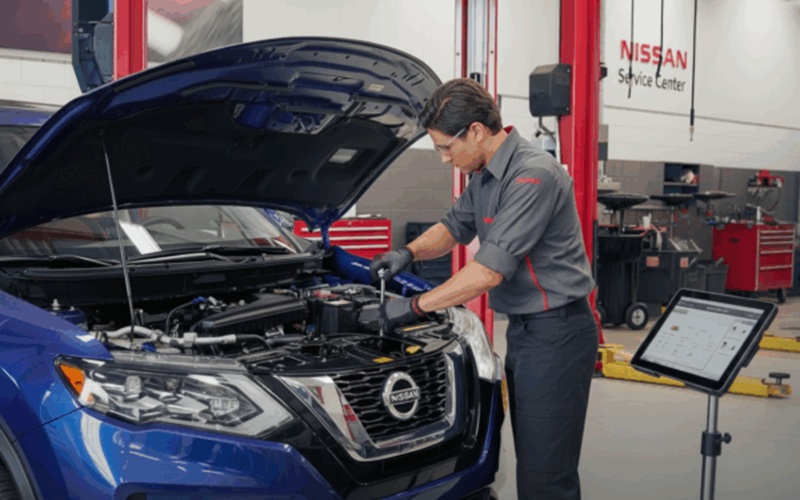
A basic pre-trip inspection helps determine whether the Rogue is ready for several hours of highway travel. Tires, fluids, brakes and warning indicators deserve particular attention because problems with these components can affect safety and vehicle operation.
Tire Pressure, Tread and Overall Condition
Tires play a major role in highway stability, traction and braking performance. Before a long trip, check the pressure when the tires are cold and compare the readings with the specifications on the vehicle’s Tire and Loading Information label.
Incorrect tire pressure can affect handling, tire wear and fuel consumption. It may also contribute to excessive heat buildup, particularly during sustained highway travel.
While checking pressure, inspect each tire for visible damage, uneven wear, excessive tread wear and objects embedded in the tread. Regular tire rotation also promotes even wear and helps maintain consistent tire performance.
Tire condition becomes especially important on road trips involving wet pavement, snow, or changing temperatures. A tire that appears adequate for short local trips may still need attention before extended highway travel.
Engine Oil and Fluid Levels
Engine oil lubricates internal components, helps remove debris, and helps manage heat. Maintaining the correct oil level and following the applicable oil-change interval are important for long-term engine operation.
Before departure, confirm the engine oil is at the correct level and that scheduled oil and filter maintenance is up to date. Also check other fluids, including engine coolant, according to the vehicle’s maintenance requirements.
The cooling system deserves attention during long highway trips, particularly when travelling through mountainous areas or during periods of high outdoor temperatures.
For the Rogue equipped with the 1.5-litre turbocharged engine, the applicable maintenance schedule lists engine coolant replacement at 120,000 km or 60 months. Other model years may have different requirements, so confirm the correct interval for the vehicle.
Brakes and Warning Indicators
Long-distance driving can involve repeated braking, especially when traffic slows unexpectedly, or the route includes steep descents.
Brake pads and rotors should have sufficient service life remaining before a major trip. Unusual noises, vibration during braking, or changes in pedal response can indicate the braking system needs inspection.
Address dashboard warning lights before departure. Even if the Rogue drives normally, an active warning may indicate a condition that needs diagnosis.
Resolving unusual symptoms before a trip reduces the chance of encountering an unresolved mechanical problem far from home.
Does Intelligent All-Wheel Drive Help on Long Trips?
The Nissan Rogue offers Intelligent All-Wheel Drive, which can provide additional traction capability when road conditions change. This can help on routes with wet pavement, snow-covered roads, or varied terrain.
The Rogue AWD system includes five selectable drive modes:
- Auto: For general driving conditions.
- Eco: For driving with an emphasis on fuel efficiency.
- Snow: For slippery, snow-covered conditions.
- Sport: For a more responsive driving character.
- Off-Road: For suitable lower-traction surfaces.
These modes let drivers choose a setting that matches different road conditions. However, available AWD equipment and drive modes vary by Rogue model year and configuration.
All-wheel drive does not replace proper tires or careful driving. Although AWD can help the vehicle gain traction, it does not eliminate the effects of slippery pavement on braking distance or cornering grip.
For winter highway trips, tire condition, appropriate seasonal tires and speed adjustments remain essential regardless of the drivetrain.
How Fuel-Efficient Is the Nissan Rogue on the Highway?
Fuel consumption affects both travel planning and how many stops you need on a longer journey.
The Nissan Rogue has published fuel-consumption ratings of approximately 6.8 L/100 km on the highway and 8.3 L/100 km in the city. Combined with its 55-litre fuel tank, these figures help estimate fuel requirements.
However, real-world consumption can differ considerably from the published ratings. Highway speed is one factor, but vehicle load, weather and terrain also influence how much fuel the engine uses.
Conditions that may increase fuel consumption include:
- Strong headwinds and cold temperatures
- Winter tires and snow-covered roads
- Heavy luggage or additional passengers
- Roof-mounted cargo carriers
- Frequent acceleration and changes in speed
- Steep hills and mountainous terrain
For example, a Rogue carrying several passengers and luggage through mountainous terrain may use more fuel than the same vehicle travelling at a steady speed on a relatively flat highway.
Rather than relying on the maximum theoretical range, plan fuel stops with an allowance for changing conditions. This is especially useful on routes where fuel stations are farther apart.
Is an Older Nissan Rogue Reliable for Highway Travel?
Older Rogue models can also handle long-distance driving, but their condition and maintenance history become increasingly important.
The Rogue has used different engine configurations across model years, and maintenance requirements have changed accordingly. For example, certain 2023 Rogue configurations use a 1.5-litre turbocharged engine, while others have a 2.5-litre engine.
These differences matter because you shouldn’t automatically apply one engine’s service requirements to another.
When evaluating a used Rogue for frequent highway travel, maintenance records provide valuable information about how the vehicle has been cared for. A vehicle with consistent servicing and no unresolved mechanical problems may be better prepared for a long journey than one with incomplete records, regardless of the odometer reading.
Key areas to review include engine oil service history, CVT fluid maintenance (where applicable), coolant condition, tire wear, brake condition, and previous repairs.
Current mileage remains relevant, but consider it alongside the vehicle’s mechanical condition. A pre-trip inspection can be particularly useful for an older Rogue or one that has accumulated substantial kilometres.
How to Prepare Your Nissan Rogue for a Long Drive
Preparing for a road trip doesn’t necessarily require extensive mechanical work. The goal is to confirm the vehicle is properly maintained, runs normally, and can carry the intended load within its specified limits.
Before departure, complete these basic checks:
- Review maintenance history. Confirm that scheduled services are current for the model year and powertrain.
- Check engine oil and fluids. Verify that levels are correct and that no scheduled maintenance is overdue.
- Inspect the tires. Check cold inflation pressure, tread condition and visible damage.
- Evaluate the brakes. Address unusual noises, vibration or changes in braking performance.
- Check exterior lights. Confirm that headlights, brake lights, turn signals and other exterior lights operate correctly.
- Address warning lights. Investigate active warnings or unusual vehicle behaviour before travelling.
- Consider the vehicle load. Keep passengers, luggage and any towed load within the applicable payload and towing limits.
- Plan fuel stops. Account for expected fuel consumption, terrain and weather rather than relying on ideal driving conditions.
These steps are useful for both newer and older Rogue models. They also help establish whether any maintenance or repairs should take priority before the trip begins.
What to Expect During Extended Highway Travel
During a long drive, the engine and transmission will respond to changes in speed, road gradient and vehicle load. Some variation in engine speed is normal, particularly when the CVT adjusts its ratio during acceleration or while climbing hills.
Fuel consumption may also increase when the vehicle carries additional cargo, travels at higher speeds or encounters strong winds. These changes reflect the additional demands placed on the powertrain and do not necessarily indicate a mechanical problem.
However, drivers should watch for new or persistent changes in vehicle behaviour. Don’t dismiss unusual vibrations, abnormal noises, significant power loss, warning lights, or changes in braking performance as normal effects of highway travel.
If these symptoms appear, the vehicle may need inspection before you continue the journey. Identifying a developing issue early is preferable to continuing a long trip with an unresolved mechanical concern.
Is the Nissan Rogue a Dependable Choice for Road Trips?
The Nissan Rogue is suitable for extended highway travel when it is properly maintained and operating within its intended limits. The latest model combines a 1.5-litre VC-Turbo engine, an Xtronic CVT, available Intelligent All-Wheel Drive, and a published highway fuel-consumption rating of about 6.8 L/100 km.
These specifications help explain how the Rogue accommodates everyday highway driving, but they do not guarantee the reliability of every individual vehicle.
Maintenance history, mechanical condition, tire quality and correct fluid levels remain important, particularly for older models. Engine and service requirements also vary by model year, so vehicle-specific maintenance is essential.
For drivers who regularly cover long distances, the best measure of road-trip readiness is a Rogue that receives scheduled maintenance, has no unresolved mechanical concerns, and is prepared for the expected weather, terrain, and load. With those factors addressed, the Rogue can serve as a practical vehicle for longer highway journeys.
Disclaimer: Content contained in this post is for informational purposes only and may include features and options from US or internacional models. Please contact the dealership for more information or to confirm vehicle, feature availability.